Smart FRCS AI: Teaching an Examiner to Listen
A spoken FRCS viva rehearsal on web, iOS and Android — real-time voice, examiner-led follow-up and band-scored feedback
- Industry
- algarra7 Ltd (UK) — postgraduate surgical education
- Region
- United Kingdom
- Project Type
- AI product — web, iOS and Android
- Live Project
- Visit Site ↗
01
The Problem
The FRCS Section 2 oral examination is spoken. A surgeon can know the clinical answer and still lose marks because it comes out unstructured, too slowly, or falls apart under the second question. Most preparation tools are written: they test recognition, not delivery. Rehearsing aloud usually means finding a consultant or a colleague with time to play examiner — and that is the scarcest resource a trainee has. The brief was to give candidates an examiner they can sit in front of at any hour: one that asks a clinical question, listens to a spoken answer, pushes on what was actually said, and then explains the result against the standard the real examination uses.
- The examination is spoken, but almost all preparation material is written.
- Practising with a real examiner depends on senior colleagues having time.
- Feedback has to map to the band scale candidates are actually marked on.
- The same rehearsal had to work on a laptop at home and a phone on a break.
02
The Solution
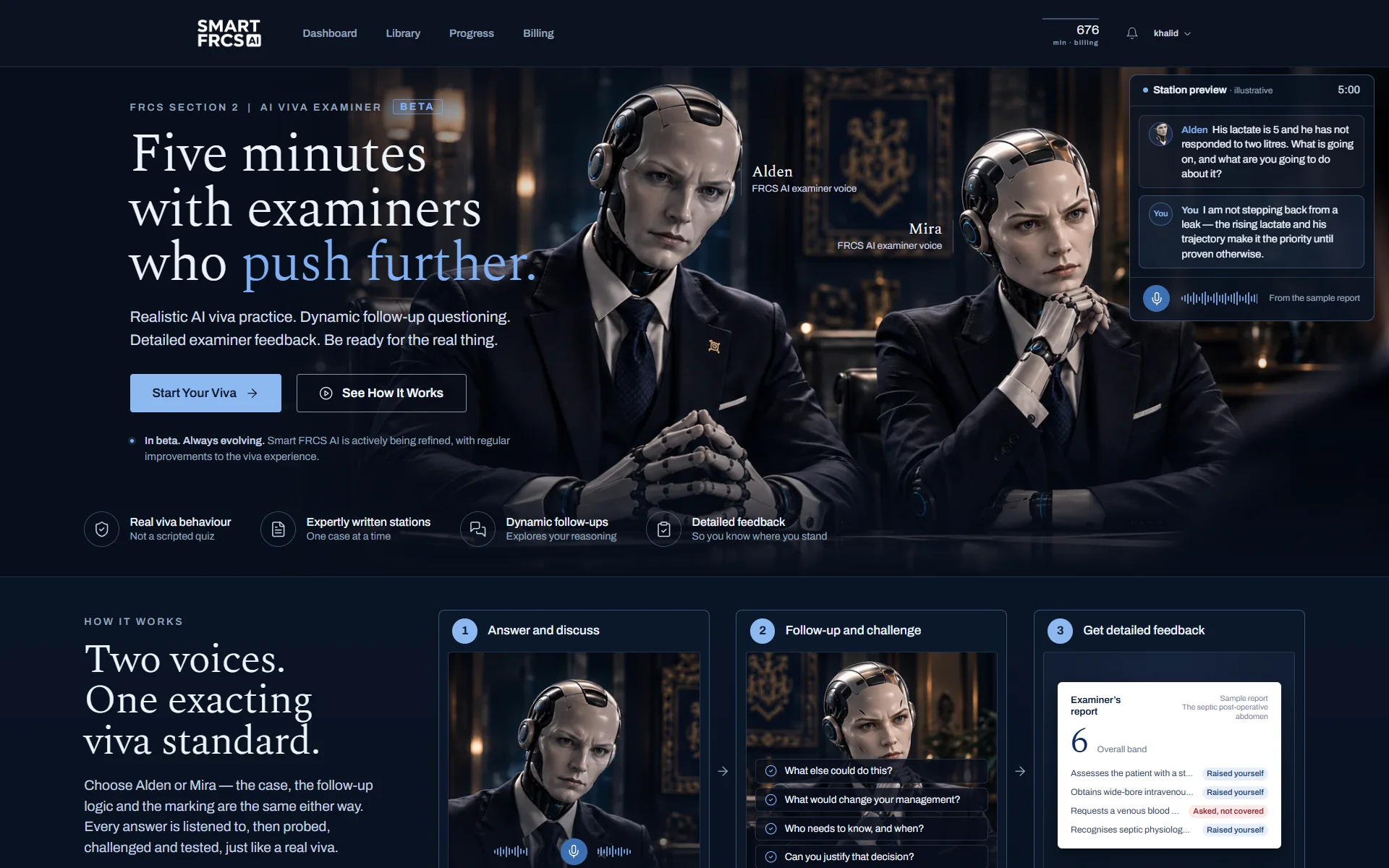
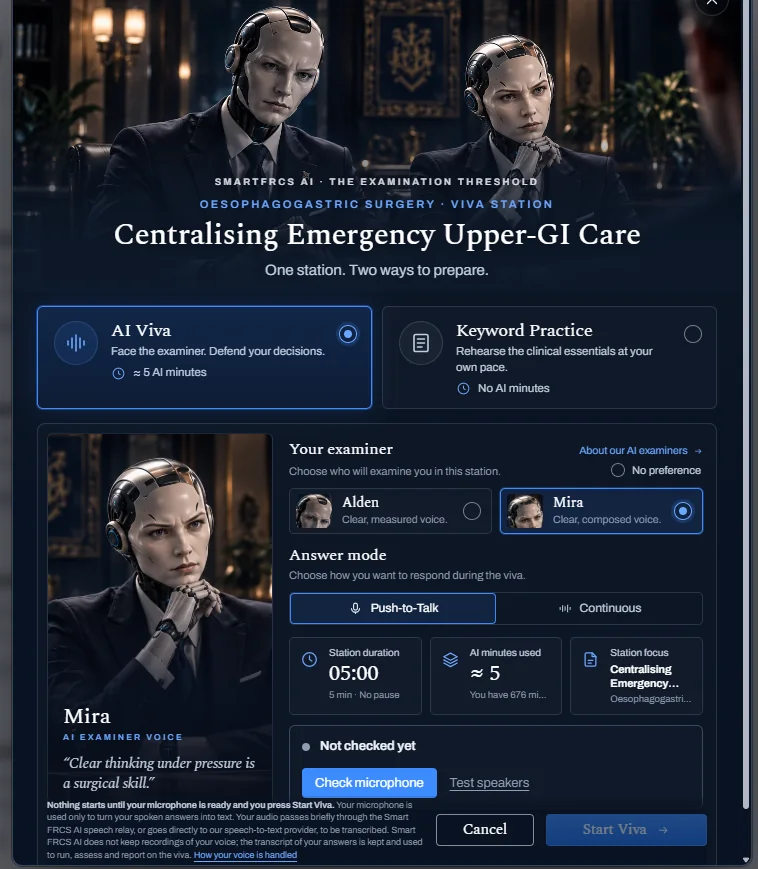
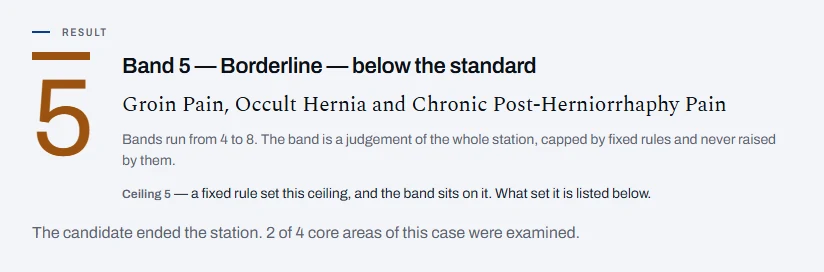
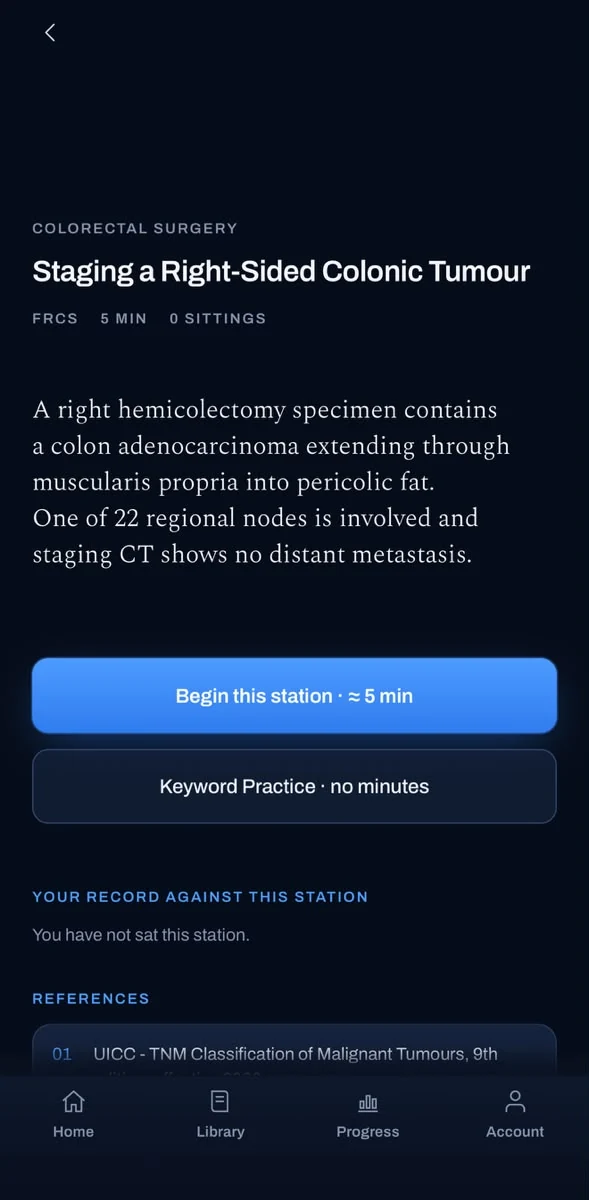
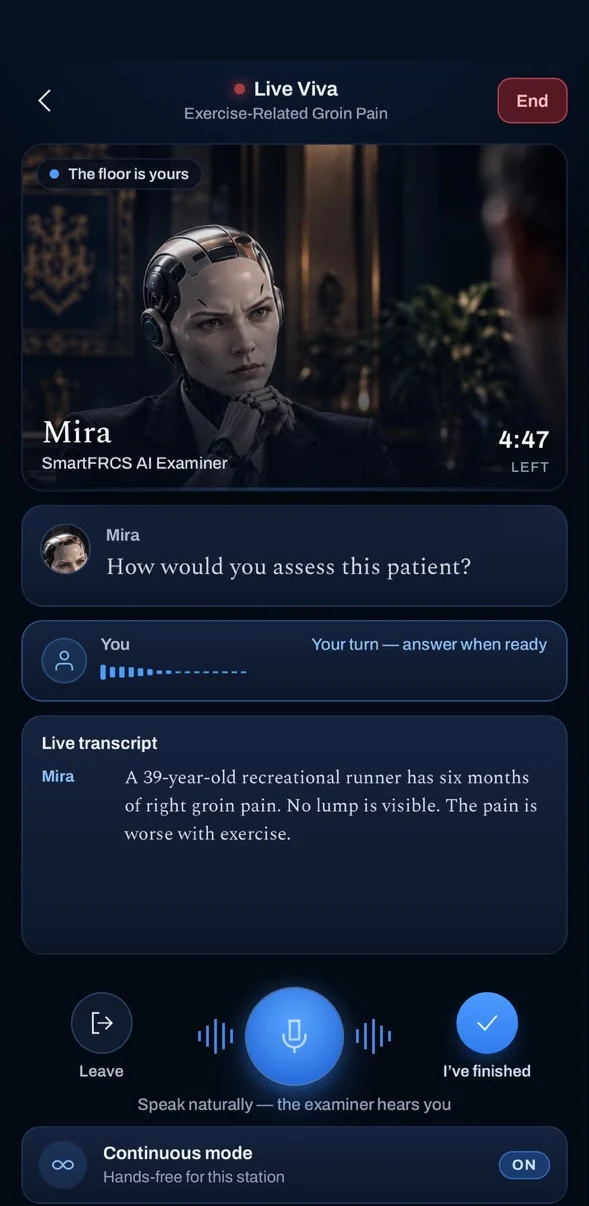
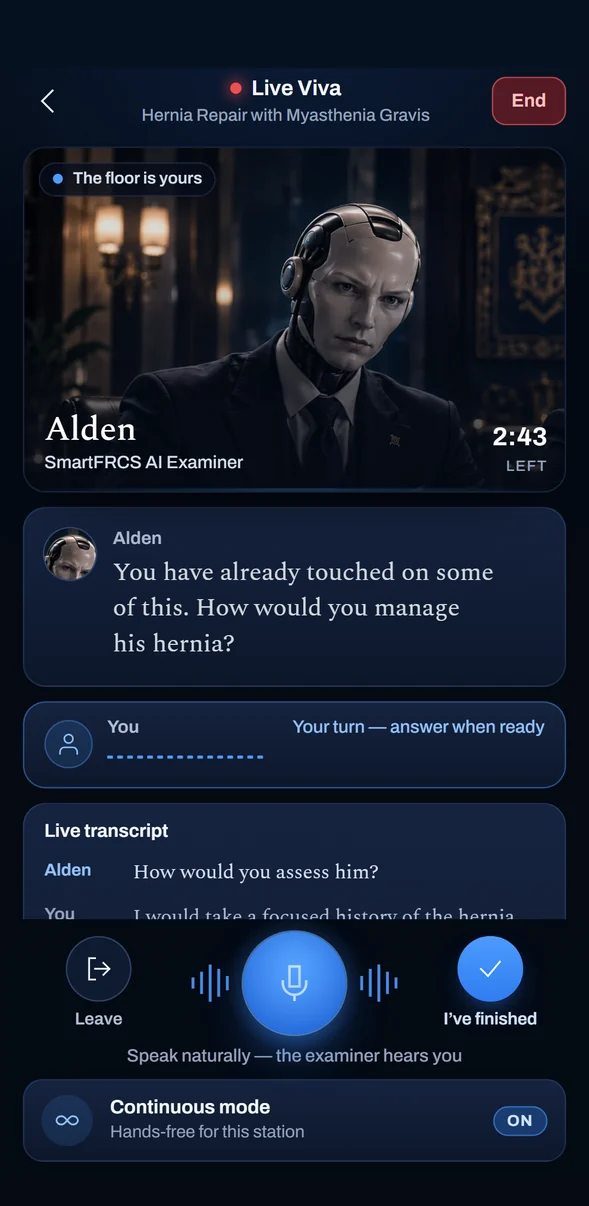
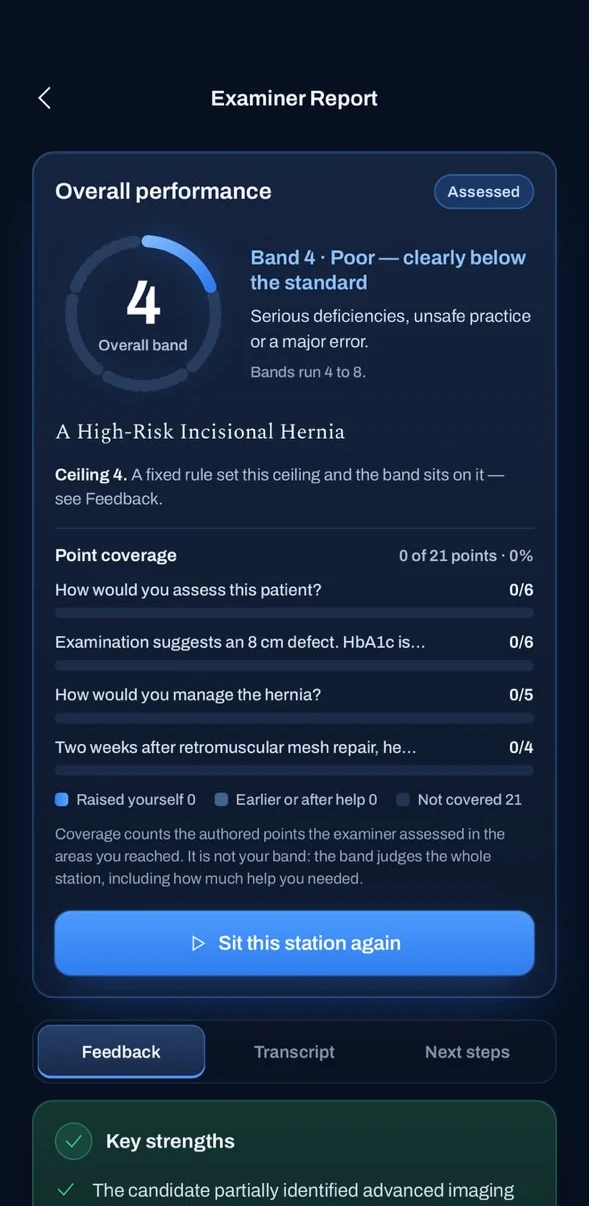
As exclusive technical partner to algarra7 Ltd, the UK company that owns the product, I designed and built Smart FRCS AI as one product on three platforms. Each clinical case is a station. Before entering, the candidate chooses an examiner — Alden or Mira, two original examiner identities created for the product, holding one examination standard — and an answer mode: push-to-talk or continuous. Inside the station the examiner asks, listens while the answer is transcribed live, and follows up on the candidate's own words rather than reading from a fixed script. The station ends with a written report scored on the Intercollegiate 4–8 band scale and an annotated transcript the candidate can replay. A separate Keyword Practice mode, scored on coverage, lets candidates revise without spending viva minutes. The web app and the iOS and Android apps share one codebase and one account, with purchases through Apple, Google and the web.
Approach
- Clinical cases modelled as stations, each with a brief, specialty and time allowance.
- Real-time speech-to-text with push-to-talk and continuous answer modes.
- An examiner that generates the next question from the transcript of the last answer.
- Scoring against the Intercollegiate 4–8 band scale, with a written report and annotated transcript.
- Keyword Practice for unmetered revision between full stations.
- One codebase for the web app and the iOS and Android apps, with an administration system behind them.
Key Decisions
- Alden and Mira are two voices holding one standard — the choice changes who the candidate faces, never how they are marked.
- Language-model calls run through a provider layer with automatic failover, so a single provider outage does not end a candidate's station.
- Viva time is metered in minutes, while Keyword Practice is unmetered — the costly path is paid, the revision path is not.
- Kept separate from the SmartFRCS question-bank app, with its own app identity, so each product can evolve on its own release cycle.
03
Screens from the product
04
Technologies & Architecture
Backend
Frontend
Database
Integration
Architecture Notes
- 1Laravel API with a React and TypeScript client in a Turborepo monorepo; Capacitor wraps the same client for iOS and Android.
- 2Voice runs through a server-side proxy to ElevenLabs realtime speech-to-text and text-to-speech, so provider keys never reach the device.
- 3Anthropic models generate examiner turns and assessment, with OpenAI as the automatic fallback.
- 4Purchases through Apple and Google in the apps and through Stripe on the web, reconciled into one minutes balance.
05
Challenges & Trade-offs
A spoken answer is messy: pauses, corrections and half-sentences. Scoring the raw audio would punish nerves rather than knowledge.
The live transcript is what the examiner reasons over and what the report annotates, so the candidate sees exactly which words earned or lost the band — and can replay them.
An examiner that only reads the next question from a list is not a viva; one that improvises freely is not a fair one.
Follow-up questions are generated from the candidate's answer within the station's clinical scope, and every station is marked against the same band scale whichever examiner voice was chosen.
Voice and AI usage have real per-minute costs, and the product is sold through three different payment systems.
A minutes-based balance shared across Apple, Google and web purchases, with unmetered Keyword Practice for the low-cost path.
06
Outcomes & Impact
Smart FRCS AI runs at smartfrcs.ai and is published on Google Play and the App Store from one codebase. Candidates can rehearse a complete spoken station end to end — brief, live examination, follow-up and scored report — on whichever device they have to hand.
- Live at smartfrcs.ai and published on Google Play and the App Store.
- A complete spoken station — brief, examination, follow-up and scored report — on web, iOS and Android.
- Two original examiner identities, Alden and Mira, carried consistently across every platform.
07
Frequently Asked Questions
- Is the examiner reading from a script?
- No. Each station starts from a clinical brief, but the follow-up questions are generated from what the candidate actually said in their previous answer.
- Who are Alden and Mira?
- Two original examiner identities created for Smart FRCS AI. The candidate chooses one per station; both hold the same examination standard.
- Can you build a voice-based AI product like this for another field?
- Yes. The hard parts — real-time voice, examiner logic grounded in a scope, structured scoring and multi-store billing — transfer to interviews, language assessment and professional training. Tell me what has to be assessed and I will tell you honestly how far AI should go.
Visit the live project to see the final result
Visit ProjectHave a Similar Project?
Let's discuss how I can help achieve your technical objectives